Three posts RLF already published, rewritten for the person searching rather than the attorney reading, with headers, a full email template and social carousels in the firm's own colours.
Three design options for the same masthead, not three topics. Any issue can run under any of them. Built from the firm's logo and its two colours, navy and orange, with the logo placed unaltered so each layout is designed to hold it rather than sit behind it.


Pick one. Each shows the subject line, the B test and the post it rewrites, then the email as a subscriber would see it.
Your mother left you money. You put it in the account you and your spouse already had, because that is where money goes.
In New York, an inheritance is normally yours alone. Separate property. It is not supposed to be divided if the marriage ends.
But the protection is not automatic, and it is not permanent. Once inherited money is mixed into accounts you share, the law stops treating it as obviously yours. It is now presumed to belong to both of you, and if you want it back, you are the one who has to prove it was ever separate. That is a hard thing to prove years later from old statements.
A New York court looked at exactly this recently. Inherited funds went into a joint investment account. The court found they had become marital property and split them, because the spouse claiming them could not show clearly enough that they had stayed separate after the money was mixed.
Nothing was done wrong here. Nobody hid anything. The money just went into the normal account, the way money does.
If you have received an inheritance, or expect to, three things are worth knowing now rather than later.
If you are not sure how your inheritance is currently held, that is a short conversation worth having.
We can review how your separate property is held and what it would take to keep it that way.
Schedule a consultation![]() Ksenia G Rudyuk Founder of the Firm | ![]() Howard Gardner Senior Litigation Attorney | ![]() Jaclyn Zackowitz Associate Attorney |
Every consultation is with an attorney, not an intake screener.
The job ended in March. The child support order was written when you were earning what you earned in 2023.
Here is the part that catches people: the order does not adjust on its own. It keeps running at the old number. Arrears build at the old number. Nobody at the court knows your income changed until you tell them, formally, through a filing.
So the months between losing the income and filing are not forgiven later. They are owed.
New York courts will look at a genuine, substantial change in circumstances. But they look hard at whether the change was truly outside your control. A layoff reads differently from a resignation. A documented health problem reads differently from a career change. And if a court decides you reduced your own income on purpose, it can calculate support on what it believes you could be earning rather than on what you are actually earning. That is called imputed income, and it surprises people.
What actually helps, in order.
If your income has dropped and the order has not moved, the gap is growing while you read this.
We can tell you whether your situation supports a modification and what a filing would need.
Schedule a consultation![]() Ksenia G Rudyuk Founder of the Firm | ![]() Howard Gardner Senior Litigation Attorney | ![]() Jaclyn Zackowitz Associate Attorney |
Every consultation is with an attorney, not an intake screener.
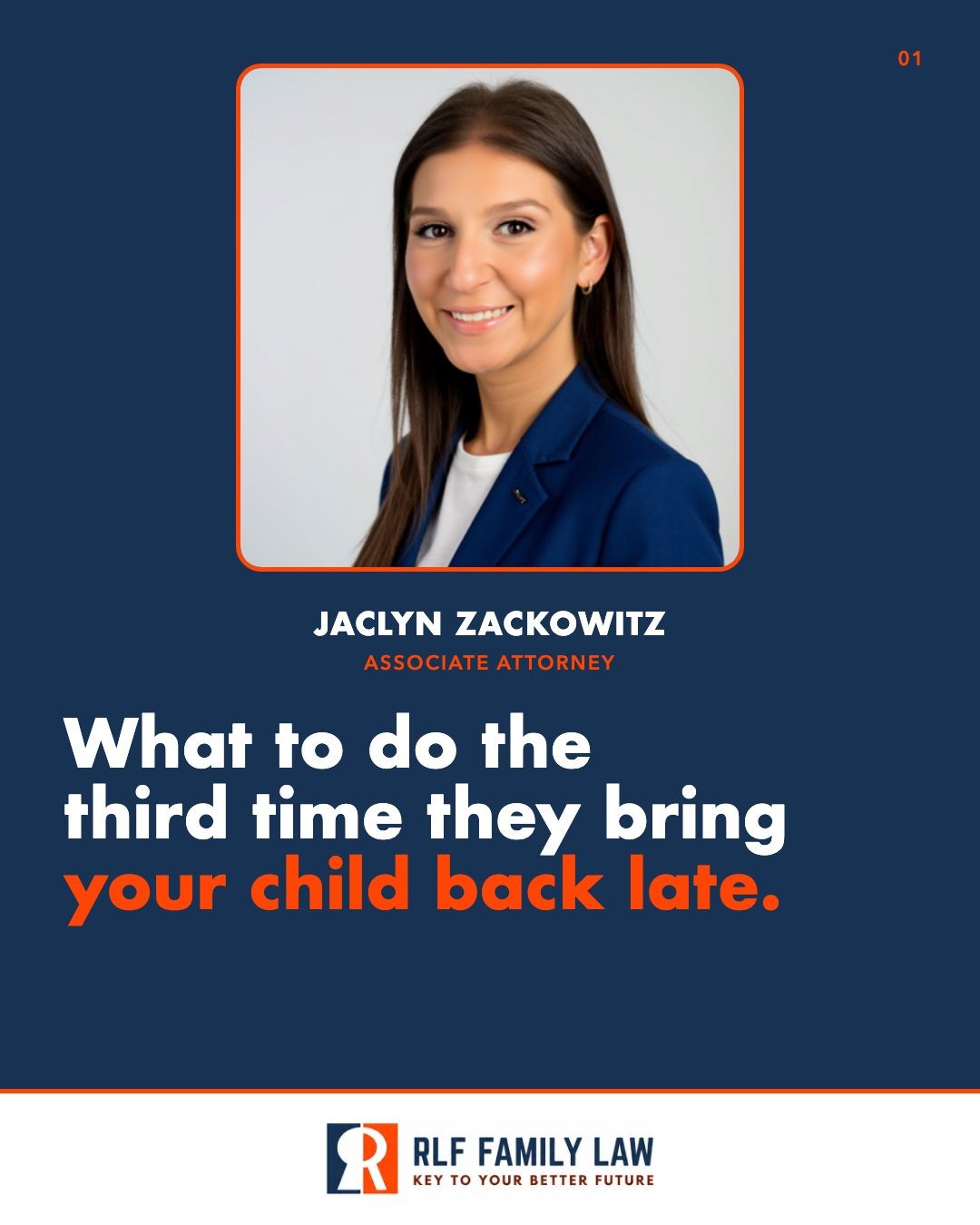
The agreement says Sunday at six. It has been seven-thirty for a month.
On its own, a late handoff is not worth a court filing. But a pattern is different from an incident, and the difference between the two is entirely in whether you wrote it down.
This is the part most parents get wrong. They remember. They are certain. They are also, two years later, trying to describe a pattern from memory while the other side describes it differently, and a judge has to choose between two accounts with nothing underneath them.
So document it, plainly, starting now.
A custody order is a court order. It is enforceable. Courts can enforce it, modify it, and in serious cases treat violations as contempt. But courts act on what can be shown, and the parent who arrives with a record arrives with an advantage that cannot be manufactured later.
The other thing worth saying: enforcement and modification are different doors. Wanting the existing order followed is not the same as wanting a new one, and which door you are walking through changes what you need.
If this has been going on for more than a few weeks, it has stopped being a scheduling problem.
We can look at what you have documented and tell you which option fits.
Schedule a consultation![]() Ksenia G Rudyuk Founder of the Firm | ![]() Howard Gardner Senior Litigation Attorney | ![]() Jaclyn Zackowitz Associate Attorney |
Every consultation is with an attorney, not an intake screener.
The same three pieces cut down for Instagram and LinkedIn, five slides each, with a different attorney fronting one apiece.